1 - Tell us a little bit about yourself. (i.e. where you were born, where you grew up, etc.)
- I was born in Athabasca, Alberta, Canada and was raised on a farm around Grassland, Alberta until I was 14 and then finished high school in Lac La Biche. I didn't know what career path to choose, but I was very good at mathematics, trigonometry, and physics. So, on the advice of my teachers, I stupidly enrolled in engineering at the University of Alberta in 1966. In my second year of Engineering I missed over 85 percent of my classes and still ended up with the 7th highest grades out of 250 engineers. Even so, it took 7 years for me to complete a 4-year program because I quit twice and stayed out a year. You can read more about this in an article called The Joy of (Not) Engineering.
After working for Edmonton Power for five and a half years, I was fired for taking two months of unauthorized vacation. My firing was, in fact, the best thing that ever happened to me because I hated being an engineer. (Just as important, I hated corporate life.) As Hal Lancaster once said, "Getting fired is nature's way to telling you that you had the wrong job in the first place." I am proud to say that I have not had a real job for 28 years.
2 - For those who have not read the book, how would you describe the central idea in the The Joy of Not Working??

- The Joy of Not Working is all about learning to live every part of your life - employment, unemployment, retirement, and leisure time alike - to the fullest. If you have a job, the book is about how to thrive at work by being more leisurely. If you are unemployed, the book will help you be happier than most people who have jobs, simply because happiness is a matter of choice, whether you have a job or not. If you are retired, The Joy of Not Working will help you find just as much purpose - even more - as you had in your career life.
3 - Some people have read the book and are left with the impression that you are encouraging people to be lazy and unproductive. What do you say to that?
- On the contrary. I am encouraging people to have a better balance between work and play, which will make them more productive. Take me, for example. I work only 4 or 5 hours a day and earn an income twice that of most people who work 8 hours a day. This makes me 4 times as productive as the average person.
4 - If one was to follow your advice and start leading a life of leisure, wouldn't it be quite difficult to maintain the same standard of living?
- First, the important question that arises is "Does one really have to live at the same standard of living?" Studies show that Americans were happiest during the 1950s. Today Americans have houses two to three times as large as in the 1950s, eat a lot more (look at all the fat people in the US), and consume two to three times as much. Yet they are not as happy. The point is that standard of living does not contribute to happiness. I have a friend who is 62 and lives on $434 a month. He actually saves some money certain months. The important point is that he is happier than 95 percent of people in society.
Second, if you become more leisurely, you may just end up making more money, and increasing your standard of living if you want to. That has happened to many people. Tim Ferris (whose book I recommend later) used to work 12 hours a day and earn $40,000 a year. Now he works 4 hours a week and earns $40,000 a month. Similarly, several people I know work hard 8 to 10 hours a day and earn $50,000 to $60,000 a year. I leisurely work only 4 hours a day and have an pretax income of about $125,000 a year. This is about working smart and not hard - but most people are too hard-headed to grasp this concept and actually follow it.
5 - What do you think is the biggest factor that stops people from changing their lifestyle?
- Most people are too programmed by society and society's values. They don't want to risk and be different. As a matter of fact, they are so plugged into mainstream thinking, they don't realize how programmed they are. This even applies to the highest of educated people such as doctors, lawyers, dentists, and university professors.
6 - Now that you are living a life of leisure, how are you spending your time?
- I usually sleep in until 11 AM or noon. My first priority is going for a rigorous run or bike ride. (This normally takes about one and a half hours of my time. After I get out of my house, and arrive at one of my favorite coffee bars, I spend about 4 hours a day working. Another 2 hours is spent talking to people in coffee bars. The evening is left open and I can do a variety of things including visiting people, reading, or meeting someone for a drink in a bar. I normally get to sleep around 3 AM after reading the newspaper and having a snack.
7 - Name a book that you think everyone should read, and why.
- The 4-Hour Workweek by Tim Ferris. This book is written for ordinary people who want to accomplish extraordinary things with minimal time involved. Some of the most important principles in this book are:
- The Lazy Person's Guide to Success: How to Get What You Want Without Killing Yourself for It
- Real Success Without a Real Job: The Career Book for People Too Smart to Work in Corporations
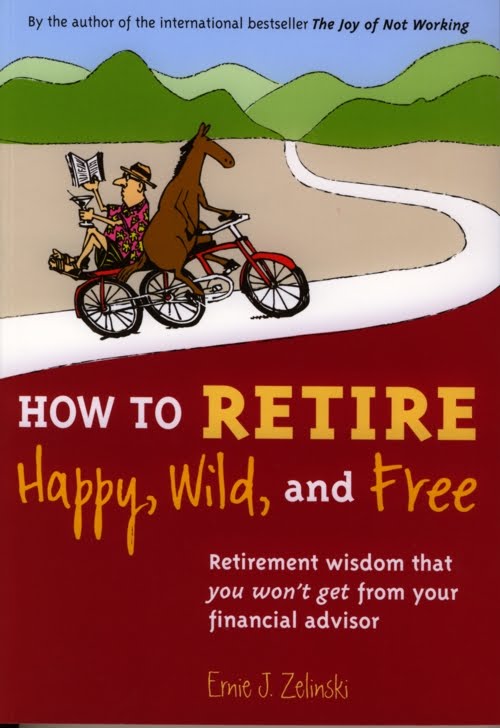
- How to Retire Happy, Wild, and Free: Retirement Wisdom That You Won't Get from Your Financial Advisor
- The Lazy Person's Guide to Happiness
- 101 Really Important Things You Already Know, But Keep Forgetting
- 1. Get unrealistic.
2. Practice the art of nonfinishing.
3. Cultivate selective ignorance.
4. Do NOT multi-task.
5. Outsource as much of your life as you can.
6. Being busy is a form of laziness - lazy thinking and indiscriminate action.
7. Forget about time management.
Here are four of several favorite quotes from The 4-Hour Workweek
1. If you are insecure, guess what? The rest of the world is, too. Do not overestimate the competition and underestimate yourself. You are better than you think.
2. The blind quest for cash is a fool's errand.
3. Ninety-nine percent of people in the world are convinced they are incapable of achieving great things, so they aim for the mediocre. The level of competition is thus fiercest for "realistic" goals, paradoxically making them the most time-consuming and energy consuming.
4. The fishing is best where the fewest go, and the collective insecurity of the world makes it easy for people to hit home runs while everyone is aiming for base hits.
8 - Do you have any plans for a follow up to the Joy of Not Working?
- I have already written and published 3 follow-up books related to The Joy of Not Working which are:
For the record, How to Retire Happy, Wild, and Free was rejected by 35 publishers - even by my own publisher Ten Speed Press that publishes The Joy of Not Working - and had to be self-published.
With an order that I received last week from Allstate Financial for 3,700 copies, How to Retire Happy, Wild, and Free has now sold over 100,000 copies.
I have also sold rights to nine foreign publishers. The cool thing is that I have now realized a tidy pretax profit of $350,000 on this self-published book - much, much more in earnings than I would have received from a major publisher.
For anyone interested, I provide over half - mainly the top half - of How to Retire Happy, Wild, and Free as a free E-book download on the Creative Free E-Books Webpage at the Real Success Resource Center ( http://www.real-success.ca/free_ebooks.html ) as well as on The Retirement Quotes Cafe.
NOTE: I have also written these books:
9 - What advice do you have for someone who will be cutting back on work and investing the money they have now?
- Contrary to popular belief, you can actually cut back on work and earn more money. Again, work smart and not hard.
When it comes to the secret of handling money, there are two principles: The first one is: Spend less than you earn. If this won't work for you, then the second principle is definitely for you: Earn more than you spend.
A lot more North Americans could retire early and have a comfortable retirement if they followed my principles. As I tell my friends who claim they have money problems, "You don't have a money problem. You have a serious thinking problem." Unfortunately, most people in North America end up believing that they "need" all the things that they buy. Fact is, most of the things people buy are "wants'. Regardless of who you are, your needs have always been provided. Plain and simple, if they weren't, you would be dead! So stop fooling yourself that you need all those material goods to be happy and you will have no problem saving.
I semi-retired when I was 35 and had a net worth of minus $30,000. Even though I have worked less than half of my adult life and have never made a penny in house appreciation (simply because I rented for all these years), I can retire comfortably.
I recommend this well-titled book for which I have adapted a short review from two other reviews:
You're Broke Because You Want to Be: How to Stop Getting By and Start Getting Ahead, by Larry Winget.
The author is a no nonsense guy and a master of tough love. This book will tear down every excuse you can think of and show you that it's your choices that are making you broke. Warning: The author is harsh. So if you get upset about that, maybe you should pass on this one, continue to blame your problems on someone else, and end up broke in retirement.
To be sure, there's no sweet talk in Winget's advice, who summarizes money management to these points: Get off your duff and start doing the hard work necessary to make financial success happen. His advice includes: Give up cable TV. Get a cheaper car. Move to a more-affordable home. Live on what you earn.
10 - Can you tell us who you will be voting for in November, and why?
- I will not be voting in November because I am Canadian. If I could vote in the American election, I would vote for the Democrats even though I am more of a conservative than a socialist. To me, the Republicans have absolutely no integrity. They talk about fiscal responsibility but are running unheard of deficits after taking power from the Democrats who under Bill Clinton were running surpluses.
The situation is no different in Canada. Again, to me, the Conservatives have no integrity in regards to fiscal responsibility. The Liberals were much more fiscally responsible when they were in power than the Conservatives are now. So on October 14th, if I vote, instead of voting Liberal, I will actually vote for the New Democrats (a socialist party!) simply because the New Democrat candidate in my riding has a chance of beating out the Conservative candidate.

- Indonesian Edition of The Joy of Not Working