Showing posts with label money. Show all posts

Sunday, October 25, 2009

6 Traits of the Person Likely to Fall for a Ponzi Scheme


My Retirement Plan Was in Place But Bernie Madoff with My Money!
So what are the 6 traits of the typical person likely to fall for a Ponzi scheme?

The answer may surprise you:

Here's a snapshot of a typical financial fraud victim:

  • Age 55-65.
  • University/College-educated.
  • Higher-than-average income.
  • Risk-taking personality.
  • Recent change in health or finances.
  • More financially literate than average.
Here are some quotes about money from The 777 Best Things Ever Said about Money to keep money in proper perspective:
  • Your wealth can only grow to the extent you do.
    — T. Harv Eker
  • Always leave enough time in your life to do something that makes you happy, satisfied, even joyous. That has more of an effect on economic well-being than any other single factor.
    — Paul Hawken
  • It's better to be out of money than out of new creative ideas on how to make money.
    — Unknown wise person
  • Empty pockets never held anyone back. Only empty heads and empty hearts can do that.
    — Norman Vincent Peale
Check out;


Paper Losses Are Real Losses, Stupid

How to Become a Millionaire

Never Lend Money to a Friend - You Will Likely Lose Both!


Friday, August 14, 2009

Create More Money for Your Retirement


Most of the articles I see on Google Alerts for anything relating to retirees has to do with money, their retirement portfolios, and how many of them are short of money.

I am amazed by the number of people that I know who want more money in their lives but are not willing to put in the time, effort, and creativity to generate more income.

If you are short of money, you likely aren't using your time, effort, and creativity to generate more retirement income. Either that or you don't handle money that well.

Here are some ways to attract money into your life according to Joe Vitale that can add to your retirement income:

  • Take action on an idea you have.

  • Write a script of you being wealthy and how it feels.

  • Forgive yourself and others.

  • Read Think and Grow Rich.

  • Turn a problem into a product and sell it online.

  • Feel grateful for something you have.

  • Pray.

  • Create a vision board of what you want.

  • Do 5 things each day on items on your vision board.

  • Ask for help.

  • Help someone else. (by hiring them to help you)

  • Do whatever you are afraid to do. Wealth is hiding behind your fear.

  • Get a retirement job. While you pursue your dream, feed yourself with work.

  • Get clear of limiting beliefs about money

Sunday, July 19, 2009

Make a Fortune in Real Estate or Stocks


I received this e-mail the other day:


    ----- Original Message -----
    From: "Eye on Worldwide Admin"
    To: Vipbooks
    Sent: Thursday, July 16, 2009 12:59 PM
    Subject: Question for you...


    Hi
    Ernie,

    My name is Nick Johnson and I own EyeOnWorldwide.com, an overseas living and real estate investment website. We have a program on the site where we interview an industry expert each month on a certain topic in overseas real estate and other related content for our subscribers. After reading about your books and some of the articles you've written online, it's clear that you fall into the category of an industry expert.

    Anyway, would you be open to doing a telephone interview about real estate investment in the coming weeks?

    I look forward to your reply.

    Kind regards,
    Nick Johnson
    Eye on Worldwide
This was my reply:


    Hi Nick:

    Thanks for the invitation to interview me for your website.

    I don't consider myself an expert in real estate, however.

    Although I am not broke by any stretch of the imagination, I often joke with my friends that "If you want to make a fortune in stocks or real estate, just look at what I am investing in, and do the opposite."

    When I look at why I have a nice nestegg of cash and investments sitting in several banks, and have my half-duplex almost paid off (even though I bought at the height of the market in 2007), I know that my best investments have always been in the books that I have written and that no major publishers wanted to publish.

    I have self-published several books and always proven the experts wrong. I am presently writing a book called The Joy of Being Retired: 101 Reasons Why Retirement Rocks (and Work Doesn't). If the publishers turn it down, I will self-publish. That's what happened with How to Retire Happy, Wild, and Free, which is well on its way to making me $400,000 in pretax profits.

    Anyway, if you want to interview me about making money by self-publishing or escaping the corporation and still making an income better that 90 percent of corporate workers, I will be happy to do an interview.

    In the mean time, I have attached my E-book (in PDF format) 101 Reasons to Love a Recession and the E-book (also in PDF format) that has over half of my book
    Career Success Without a Real Job.

    So long for now,

    Ernie Zelinski
    World Class Author, Innovator, and Corporate Escape Artist
    Author of the Bestseller
    How to Retire Happy, Wild, and Free
    (Over 100,000 copies sold and published in 7 foreign languages)
    and the International Bestseller
    The Joy of Not Working
    (Over 225,000 copies sold and published in 17 languages)

Saturday, February 14, 2009

No Job and Little Money But Still Inspired


Here is the latest e-mail that I received about my books:


    ----- Original Message -----
    From: Nadine Myers
    To: vip-books (at) telus
    Sent: Thursday, February 12, 2009 7:54 AM
    Subject: You're Awesome!


    Hi Ernie!

    I just needed to contact you today because a fire has been lit in my belly and I have to say that I believe that it is mostly because of you!

    A couple of years ago a few things happened that made me realise that the corporate world was not for me. I tried network marketing around my day job which I also found was not for me, so just went from contract role to contract role and decided I needed a bigger change and there seemed to be a big pull towards Canada. So here I am!

    I am back working in the Corporate world but with the mentality that I will only be here until I get bored then I will move on. I am busy with a non-real job outside of this (www.NabThatJob.com), however I am not earning enough money yet from this to leave my day job.

    I also have a lot of debt (not unlike yourself when you first started your life of freedom) and no money behind me, as well as some investments that require payments every month.

    I first came across
    The Joy of Not Working in a second hand book shop and reading about how you started lit a flame in me and inspired me further.

    After many frustrations in my current job I was lead to your new book,
    Real Success Without a Real Job and as soon as I started reading it last night I could not put it down!

    You are such an inspiration to me and I want to thank you because I know that I will be there one day very soon.

    I am weighing up options and at this stage I'm thinking I will stick out this job for one year to get my debts cleared and reduce my outgoings every month. I will then be able to comfortably live on minimum income and therefore will have less pressure to pay bills etc. I do not have
    many friends in Canada and so no-one to fall back on here, although that does not scare me.

    I just needed to thank you for leading such an awesome path and for writing these materials to help people like me to feel more comfortable about this leap out of society!

    I look forward to bumping into you in one of your many offices (i.e. a coffee shop) one day!!

    Have an awesome day & rest of the week!

    Cheers,

    Nadine


    Nadine Myers
    Nab That Job in Australia!


Check out:


Sunday, January 18, 2009

How to Survive a Recession in Style


    My family wasn't affected by the crash of '29. They went broke in '28.
    - Gerald Barzan
    Here is what a Squidoo Lens Maker Says about the benefits of a recession and how it will help you survive a recession:
    • A recession makes you wiser
    • A recession makes you think out of the box
    • A recession makes a decision maker out of you.
    • A recession makes you appreciate what you have.
    • A recession forces change
    Here is one way on how to survive a recession in style:

    I just received the following letter from Raúl Mellado in Spain:


      Dear Mr. Zelinski,

      I am writing from Spain, after reading your book
      The Joy of Not Working, after a recommendation by a friend. I must say it's one of the funniest — yet at the same time useful book I've ever read.

      When I told my colleagues I was quitting my job as a computer engineer to move with my girlfriend to a little island (called La Palma) in the middle of the Atlantic Ocean, where we had no job, no house; just a couple of friends living there and nice weather all year long, they all said I was crazy.

      Now, looking back, I think it's them who are crazy for staying where they are! I clearly remember one coffee break, talking about what we would do if we won the lottery. And absolutely no one would stay where we were.

      So I thought, if you don't like what you do, Why keep doing it?

      Here, in order to pay the rent for our flat, my girlfriend takes somesporadic jobs as a nurse, and I use my computer skills from time totime on some projects, but most of the time, we are free. We havereduced our expenses to the minimum, and our capacity to enjoy lifeto the maximum!

      We have walks in nature, read the newspaper lying on the beach, several books (one per week is our aim,) learn new recipes and cook our slow-food, learn new languages, etc.

      I am 26, and she is 24. We are really happy we took this path whenwe are relatively young (no young enough to keep awake till 6 am ata party, anymore), not wasting our lives living for work.

      Also, we think this lifestyle, reducing consumption to a minimumand escaping the vicious consumerism, apart from increasing our happiness, helps our planet, working in favor of its sustainability.

      Currently, we are trying to find and develop some kind of businessin which we can enjoy ourselves and have a regular income, not working too hard. Do you have any suggestions?

      [ Answer: Yes, read
      Career Success Without a Real Job.

      Now we are looking forward to reading your latest book
      How to Retire Happy, Wild, and Free, lying on a beach.

      We would like to thank you for all we've learned with your book, andno need to say, we would really enjoy having your visit over hereone day. Just look for flights to "Santa Cruz de La Palma", in Spainand let us know what time we should pick you up at the airport.

      Best regards from Spain,

      Raúl
    Here are a three retirement quotes:
    Retirement is the beginning of life — not the end!
    — from How to Retire Happy, Wild, and Free

    Don't wait for retirement to be happy and really start living. Invariably, people who try this find out that they have waited much too long.
    — from How to Retire Happy, Wild, and Free

    To fear retirement is to fear life.
    — from How to Retire Happy, Wild, and Free


    Also check out these resources to help you survive a recession:


    Friday, October 10, 2008

    Some Things Matter More Than Money


    If your retirement funds and retirement income have taken a beating in the last two or three months, you are not alone. There are many people who feel like they are part of the group fools and their money.


    I have lost around $70,000 in my stock portfolio.

    Should I worry? Probably not.

    Years ago I wound up totally broke with $30,000 in student loan debts to my name. My creative efforts helped me get out of the financial jam. Today, I still have $200,000 or $300,000 sitting in cash deposits which is more than many people.

    Here are "10 things the credit crisis taught me about investing" that come from John Heinzl, financial writer with the Globe and Mail.


    1. All stocks are risky, even the safe ones.

    2. Buy and hold, buy and schmold.

    3. Nobody is immune.

    4. Money isn't the root of all evil, debt is.

    5. A lot of brilliant people [economists and financial analysts alike] are actually quite stupid.

    6. Just because a stock is cheap doesn't mean it won't get cheaper.

    7. Grandpa was right after all telling us to "save every nickel."

    8. We've had it too good for too long.

    9. Cash is king.

    10. Some things matter more than money.
    Indeed, some things matter more than money - in fact, a lot do.

    Friday, September 19, 2008

    The New Retirement for Baby Boomers - Going Bust and Not Being Able to Retire


    It never ceases to amaze me how most people are fools with their money. A recent report confirms my suspicions that baby boomers are just as irresponsible with their money and act on their short-term interests. Very short, term interest. Just like most young people today, instant gratification takes too long.
    Homeowners' behavior during the recent housing boom in the U.S. left American soon-to-be retirees in worse shape approaching retirement, because a house accounts for half of the property and financial wealth of the typical household approaching retirement age, according to the Center for Retirement Research at Boston College.

    Alicia Munnell, the center's director, looked into how the housing bubble affected retirement security in a recent report with Mauricio Soto, a research economist at the center.

    Here are some key findings of the report, released this month:
      • Many households reacted to the gain in housing prices by taking money out and increasing their debt. The center estimates that households extracted about $1.2 trillion of their home equity during the boom from 2001-06.

      • Total debt rose to 120 percent of disposable personal income in 2007 from about 80 percent in the early 1990s, according to government data.

      • With most of their family responsibilities out of the way, households headed by homeowners older than 50 were more likely to take out home equity. All told, homeowners 50 to 62 years old took out about $380 billion from their primary residences and posted expenses of $149 billion, based on government data from the Federal Reserve System and the Case-Shiller Home Price Index.

      • Homeowners with children were more likely to tap into their home equity, possibly to pay education and other expenses.

      • Homeowners said they spent 10.5 percent of what they took out from their primary homes on expenses, including personal spending and repayment of credit-card debt; 23.5 percent to pay off past debts; 32.2 percent for home improvement; and 33.8 percent for investment in the stock market, real estate or business.

      • For a typical homeowner nearing retirement (ages 50 to 62 in 2004), the gains in housing equity were nearly offset by additional spending. Their household net worth fell by an estimated $6,900, or 14 percent.
    The report found that people increased mortgage debt by $1.2 trillion during the housing boom and increased consumption by $410 billion.

    As I have said before, so much for houses as investments for retirement. Again, houses are consumer products and not investments. If you are buying a house on the hope that it will go up, you are speculating. If you are speculating, you should be prepared for the price to go down instead of up. Don't blame anyone else when your house price goes down. You caused this situation to happen by believing what the shady real estate agents and mortgage lenders have told you.

    If you want to be financially well-prepared for retirement, invest in yourself by spending as much money as you can on books, seminars, and motivational tapes on how to run your own business or how to make money on the Internet. Fact is, your most valuable asset is actually your ability to earn an income.

    Your enhanced earning power that comes from your superior skills and knowledge should be part of overall retirement plan. Although the banks and other financial institutions don't count intangibles such as creativity, innovative character, risk-taking ability, and specialized knowledge in tallying your net worth, you should. These items are much more important to a retirement portfolio than a house.

    WARNING! WARNING! WARNING!


    Retirement is a double-edged sword. You either make it work for you - or it will cut your happiness in half. The more you know about the secrets to a successful retirement, the happier you will be once you retire.

    That's why you need The World's Best Retirement Book by Vipbooks Author Ernie J. Zelinski.

    Retirement Gift Ideas

    Over 100,000 Copies Sold
    Published in 7 Foreign Languages


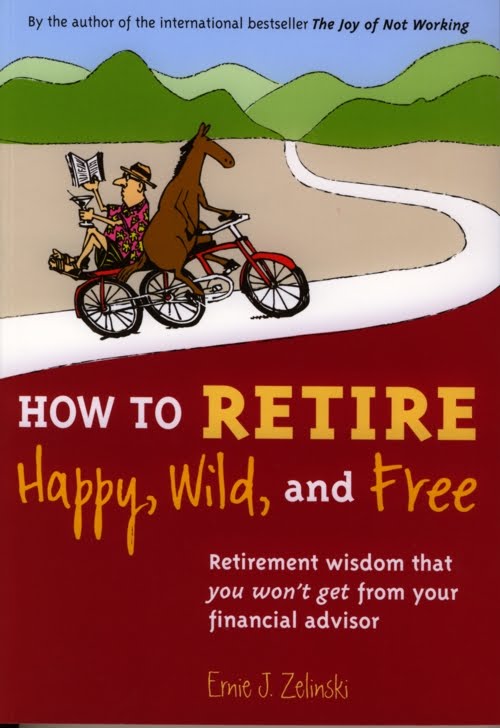
    How to Retire Happy, Wild, and Free: Retirement Wisdom That You Won't Get from Your Financial Advisor is a provocative, entertaining, down-to-earth, and tremendously inspiring book that will help you get more joy and satisfaction out of all your retirement activities.

    Although turned down by over 35 publishers, How to Retire Happy, Wild, and Free has already sold over 100,000 copies and has been published in 7 foreign languages since it was released by Ten Speed Press in Berkeley, California.

    What's more, go to www.Amazon.com and type "retirement" into the search feature. You will see that How to Retire Happy, Wild, and Free appears in the number 1 position - out of over 175,000 listings for retirement books!

    Purchase How to Retire Happy, Wild, and Free on Amazon.com with this direct link:

    Saturday, July 12, 2008

    Money Facts: Canadian Retirees Not Prepared for Retirement

    1. According to a recently released Statistics Canada study, almost half of Canadian households spend more than their pretax income in a given year. That's up from 39 per cent in the early 1980s. From 1982 to 2001, the study found, per capita debt doubled, because of sharp increases in both mortgages and consumer debt.

    2. 67 percent of Canadians say money is their most frequent worry.

    3. Only 40 percent of Canadians know how many millions are in a billion.

    4. Still worse, only 25 percent of Canadians know the difference between the National debt and National deficit.

    5. According to Desjardins Financial security's latest retirement study, many Canadians are not prepared for the challenges retirement can bring. They are failing to consider a variety of factors and risks that can have an impact on the yield and longevity of their savings, such as inflation, rising life expectancies and healthcare costs. Nearly 60% of those surveyed are not concerned about having a large enough nest egg to sustain their standard of living in retirement. More than 80% have not eliminated their consumer debt in retirement and even more are not concerned about paying off their mortgages (88%). And more than half are not worried that inflation will erode their savings.


    Monday, June 9, 2008

    How Much Money Do You Need for Retirement?

    You May Not Need as Much Retirement Income as the Experts Claim

    Contrary to the advice of those financial advisers who recommended you need 70-80 per cent of your pre-retirement income to retire comfortably, most retired people get by on a lot less.

    Surprisingly, research by Statistics Canada found that people whose pre-retirement income was $70,000 or greater tended to retire on about 45 per cent of that – or around $31,500. Those who earned around the average national wage – between $40,000 and $50,000 – retired on 59 per cent of their pre-retirement income.

    Most interestingly, only one in six people with a pre-retirement income of $40,000 or more had a replacement ratio of 75 per cent or more.

    Working in Retirement Jobs in Your Retirement Years

    According to Statistics about Retirement generated by Statistics Canada, more than 300,000 Canadians 65 or older worked in 2001:
    • 57% were 65-69
    • 26% were 70-74
    • 17% were 75 or older

    Even The U.S. State Dept Likes The Joy of Not Working

    Retirement Image of The Joy of Not Working


    Importance of Money Quotes at the The Retirement Quotes Cafe

    Tuesday, June 3, 2008

    Due to Money Baby Boomers Likely to Face a Bleak Retirement - If Any Retirement at All!


    According to MotleyFool.com, more than 39 percent of individuals who are presently in or near retirement have saved less than $25,000 for their golden years. Apparently this is the lowest American savings rate since the Great Depression.

    Actually it's worse than that. Check out the numbers from the RCS. They reflect the total savings and investments (not including the value of the primary residence) of today's workers, by age group:


    Retirement Savings


    -------Less than $25K - $25K-$49.9K - $50K-$99.9K - $100K-$249.9K - - 250K +

    All Ages - - - 53% - - - - - - - 12% - - - - - - - 12% - - - - - - - 11% - - - - - - 12%
    25-34 - - - - - -73% - - - - - - - 11% - - - - - - - 7% - - - - - - - - - 4% - - - - - - - 5%
    35-44 - - - - -49%- - - - - - - 14% - - - - - - - 16%- - - - - - - - - 12% - - - - -- - 9%
    45-54 - - - - 44%- - - - - - - 14% - - - - - - - 12% - - - - - - - - - 15% - - - - - - 16%
    - 55+ - - - - -42% - - - - - - - 8% - - - - - - - - 2% - - - - - - - - 12% - - - - - - - 26%

    Source: Retirement Confidence Survey, April 2006.

    Note that according to the above figures, half of the people 55 and over have saved less than $50,000 for retirement.


    Ernie Zelinski's Speech at the Ritz-Carlton in Istanbul

    Retirement Dinner Speeches on The Retirement Speeches Café

    Wednesday, May 21, 2008

    Letter about How to Retire Happy

    I received this email the other day:


      Dear Mr. Zelinski,

      At our financial organization, you are regarded as somewhat of a celebrity. All of our Representativeshave read your book,
      How to Retire Happy, Wild, and Free. We now make it a practice to give this book out to ourclients on every financial planning appointment.

      We would love the opportunity to speak with you about a speaking engagement at our fall conferencein Dallas, TX. The dates for this conference are September 17 & 18, 2008.

      We would like to discuss what it would take to getyou to our conference, what type of presentation you would like to do and the logistics involved.
      Our President of Field Operations would like the opportunity to contact you directly to discuss this possibility. Please let me know how we may contact you.
    After I e-mailed my contact information, there has been no answer. I wonder why . . . hmm.

    Anyway, I did receive confirmation about this gig:


    Ernie Zelinski
    vipbooks


    The money you enjoy spending frivolously to enhance your retirement is money well spent.
    — from
    How to Retire Happy, Wild, and Free: Retirement Wisdom That You Won't Get from Your Financial Advisor by Ernie J. Zelinski

    See
    retirement sayings and quotes and Importance of Money Quotes at the The Retirement Quotes Cafe

    Tuesday, February 12, 2008

    Significance of Money When You Retire

    A major dilemma faces many of us as we try to decide when is the best time to retire. It involves our finances. This dilemma is best summarized by the words of Bertolt Brecht: "Life is short, and so is money."

    Everyone has decisions to make about money and what each is willing to sacrifice in the pursuit of it. Here are a few quotations regarding money to place it in proper perspective:


    The 777 Best Things Ever Said about Money